Price, size and rarity
Buy prices follow size and rarity together. Every Common species read on 15 November 2026 cost $21 small, $28 medium and $41 large. Every Uncommon small tree read cost $24.
Notice what does not appear in that sentence: the species name. Douglas Fir and Siberian Spruce are different trees with identical prices at every size. So "which species" is a looks question and "which size" is a money question.
The other half of the equation is the tag on the tree. Two of those were legible in the recordings: Blue Spruce · 5.1 ft · $84 and Norway Spruce · Large · 9.9 ft · $182. Two tags is a pattern to test, not a price list — the panel that sets them was never on screen.
Profit per tree at your price
Hold the price fixed and the answer is arithmetic. At $84 a tree:
| Size | Buy price | Profit per tree | Margin |
|---|---|---|---|
| Small | $21 | $63 | 75% |
| Medium | $28 | $56 | 67% |
| Large | $41 | $43 | 51% |
The cheap tree wins per tree every time the price is the same, because profit is price minus cost and nothing else.
With 2x Cash the ordering does not change: $126, $112 and $86. Doubling a bigger number keeps it bigger.
Profit per crate
Now hold the crate budget fixed and the gap widens rather than flipping. $420 buys 20 small trees or 10 large ones. Sold at $84 each, the small crate returns $1,260 of profit and the large crate $430.
So the large tree has to earn more per unit to compete, not fewer. It does that only if customers pay more for size, which is what the two price tags hint at. Before you order a crate of them, check which constraint you are under:
Storage limited. You can hold 30 trees at a starter lot. Fill those 30 with the cheapest size and you get the most profit out of the space.
Customer limited. If customers pick by size — and the price tags suggest size is part of the decision — a crate of small trees may leave buyers walking away. Ten minutes of watching what people pick answers this better than any table.
Cash limited. Cheaper trees mean more trees per order, which is usually the right call early.
Reading the demand badges
The Tree Supplier marks some rows. A medium Douglas Fir carried HIGH DEMAND with 14 available. A medium Siberian Spruce carried LOW DEMAND with 10 available. A row in a rarer band carried a Rare! marker instead.
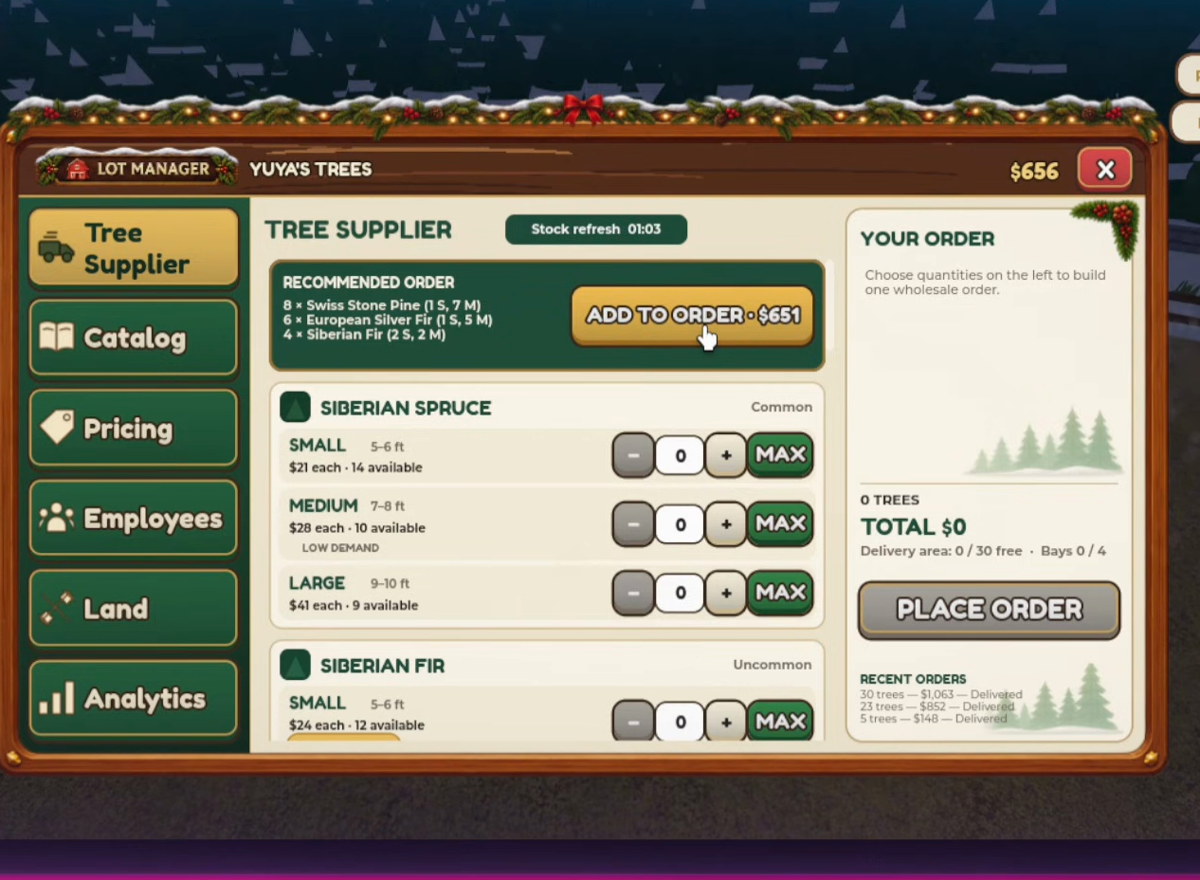
Read the badge as a note about that row right now, in this server, at this stock refresh. It does not change the buy price and it does not guarantee a sale. What it does tell you is which size the game expects customers to want.
The honest use: if your crate is all one size and that size is flagged LOW DEMAND, spread the next crate across bands and see whether the shelf clears faster.
When to change what you order
Change the mix when one of these happens.
- The cheap size keeps selling out. Same price, same profit, but the shelf empties too fast. Reorder more often or add storage.
- Trees sit unsold at the end of a session. That size is wrong for your customers, whatever its margin says.
- A tag price you can charge is much higher than you assumed. Re-run the comparison at the new price, because the ranking can change.
- You bought 2x Cash. Nothing changes in the ranking; every profit doubles.
To test a mix before committing cash, run it through the Run a Christmas Tree Lot Profit Calculator. The full price table, including the rows this site has not read yet, sits in Run a Christmas Tree Lot Tree Prices. If your shelf empties before the truck returns, the tree choice is not the problem at all — Run a Christmas Tree Lot Money Guide handles that case.